
Ozone Monitoring Campaign
Project Summary
Chemistry students at a Title I high school near Los Angeles used real air-quality sensors and a mapping app to test their own assumptions about pollution, and were surprised to find their campus air came back clean, even with LA smog and recent regional wildfires in the backdrop.
Detailed Story
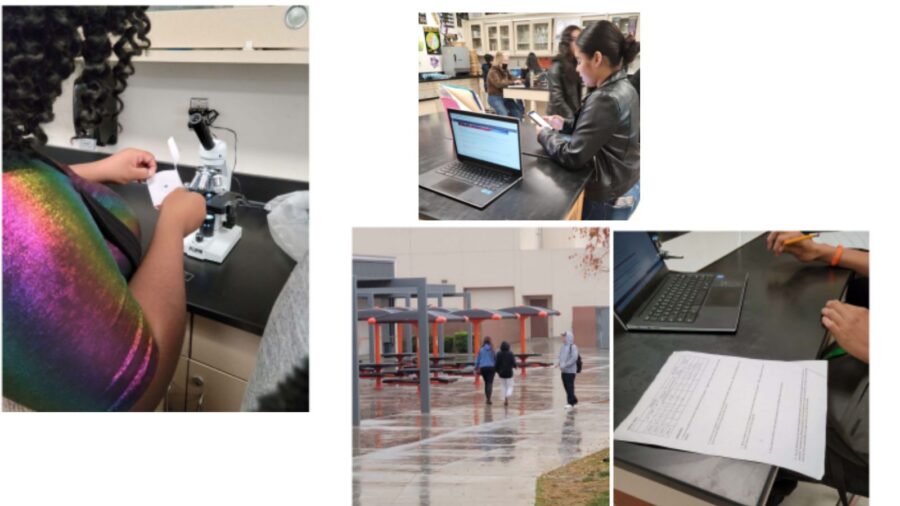
Allison’s students at San Jacinto High School — a Title I, 2,600-student campus about 45 minutes southeast of Los Angeles — took on real environmental science using professional-grade tools. Working in roughly 25 groups of 3-4 students in a 10th-12th grade NGSS chemistry class, students began by collecting particles on index cards placed around their 60-acre campus, then moved on to using AQ-go air quality sensors paired with the Aircasting app, walking the grounds with sensor-connected phones to gather real-time data.
Over several days and at different times of day, students collected 26 data points — and every single one came back in the green zone, indicating safe air quality under 12 µg/m³. The highest reading, just 3 µg/m³, showed up near the bus loading area at the end of the school day, which students attributed to exhaust. The results genuinely surprised the class: given their proximity to LA’s visible smog layer, and lingering concern about residual particles from wildfires that had burned in the region just weeks earlier, students expected worse. Being situated in a windy valley added to their expectation of higher particulate counts. Instead, they came away reassured — and with a much clearer, evidence-based understanding of their own local air quality.
Students turned their findings outward, creating posters for campus and videos shown during school announcements to raise awareness. They also generated ideas for expanding the project’s reach into the community, proposing a Parent Square text-alert system to notify families about daily air quality, along with color-coded (green/yellow/red) signage around campus — an idea students felt would be especially useful during wildfire season, potentially prompting students to wear masks when air quality dipped.
The project wasn’t without its hiccups, the AQ-go sensors repeatedly disconnected because the classroom’s WiFi ran on 5GHz while the sensors needed a 2.4GHz connection, a mismatch Allison worked around using her personal phone as a hotspot until she convinced the tech department to enable a 2.4GHz switch in her room specifically. Despite the technical bumps, students got hands-on experience with tools they wouldn’t otherwise have access to, such as microscopes, data collection apps, and environmental sensors, and, in Allison’s words, felt they were “doing real science and understanding why these tests are important to the environment and community.”
Impact Statement
Approximately 200 students collected and mapped real air-quality data across their 60-acre campus, building fluency with professional environmental monitoring tools while producing awareness materials (posters and videos) for their school community. The project also surfaced practical, student-generated ideas for community-wide air quality alerts.