
Researching Regenerative Farming’s Roots and Ripple Effects
Project Summary
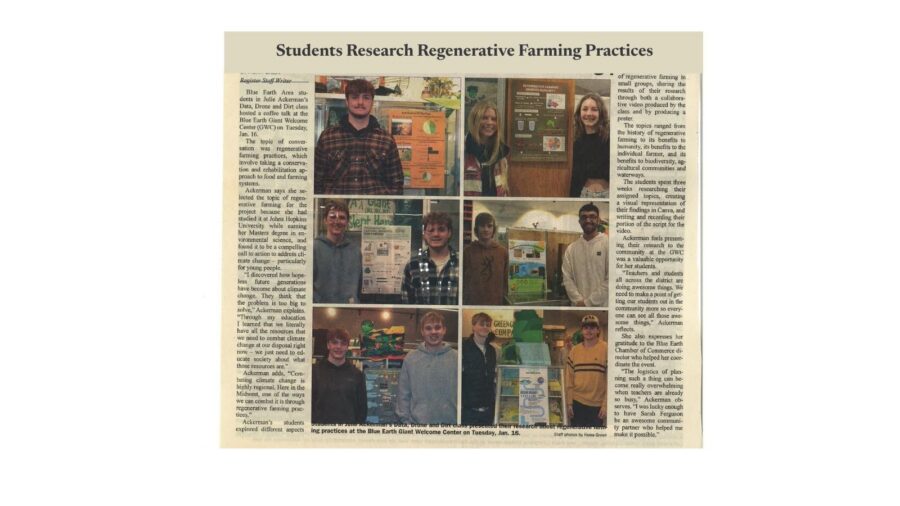
After spending three weeks researching regenerative farming’s history and impacts, Julie’s Data, Drone and Dirt class turned their findings into an original video and a series of Canva-designed posters, tackling topics ranging from soil biodiversity to farm profitability. The class presented their work publicly at the Blue Earth Giant Welcome Center in partnership with the local Chamber of Commerce, connecting classroom research directly to their community’s agricultural roots and drawing local newspaper coverage in the process.
Detailed Story
Julie, one of TCI’s longest-standing educators, has continued expanding her work connecting climate education to her students’ agricultural roots in southern Minnesota. Her Data, Drone and Dirt class spent three weeks researching regenerative farming practices, each student taking on an assigned topic and turning their findings into a visual poster using Canva, alongside a collaboratively written and recorded video. The students’ research traced regenerative farming’s importance back through history, noting that more than 20 great civilizations collapsed at least in part due to poor soil stewardship — deforestation, erosion, and overintensive agriculture that ultimately left them unable to feed their people. Framing today’s choices against that backdrop, students explored practices like strip-till farming and cover cropping, both highly relevant to local farmers. Their research highlighted a striking economic finding: while regenerative farms see roughly 29% lower yields than conventional operations, they’re 78% more profitable, thanks to reduced input costs and healthier, more resilient soil. Students also learned that each 1% increase in soil organic matter adds roughly 20,000 gallons of available water per acre — a critical resilience factor for drought. The class connected their region’s agricultural history directly to the science, noting that southern Minnesota was once native prairie, rich with hundreds of species of plants, wildflowers, and grasses that built healthy soil over time — before the shift to modern monoculture stripped much of that biodiversity away. Their video makes the case for a middle path: preserving the economic reality of monoculture farming while reintroducing diversity through cover crops to begin rebuilding what was lost. Students also researched regenerative farming’s ripple effects beyond the farm itself — improved water quality in local lakes and rivers through reduced runoff and erosion, stronger rural economies as farms thrive and reinvest locally, and broader climate benefits through carbon sequestration. On January 16, students presented their research and posters at the Blue Earth Giant Welcome Center, in partnership with the Blue Earth Area Chamber of Commerce, drawing coverage from the Blue Earth Area Register. Ackerman credited Sarah Ferguson, the Chamber’s event coordinator, for helping pull off the logistics of the presentation amid a busy teaching schedule.
Impact Statement
Students produced original research, an educational video, and Canva-designed posters on regenerative farming, then presented their findings publicly to the Blue Earth community — connecting classroom climate science to the region’s agricultural identity and demonstrating that actionable, regionally-relevant climate solutions already exist.
